If you are drawn to walls of glass, clean lines, and a strong connection to the landscape, buying a modernist home in New Canaan can feel like finding a piece of living design history. It is also a purchase that asks a little more from you as a buyer. You need to balance architecture, comfort, maintenance, and long-term value with care. This guide will help you understand what to look for, what to ask, and how to buy with confidence. Let’s dive in.
Why New Canaan stands out
New Canaan is not just a town with a few architecturally interesting homes. It became a major postwar center for residential modernism. According to the Glass House survey, more than thirty modern houses had already been built in town by the end of 1952, and more than one hundred were constructed by the end of the 1970s.
That history still shapes the local market today. New Canaan offered proximity to New York City while remaining apart from industrial development, major rail lines, and highways, with former farmland available for house sites. For buyers, that means you are not simply shopping for a style. You are buying into a place with real architectural significance.
The Glass House remains the clearest local point of reference. Built between 1949 and 1995 as a 49-acre landscape of 14 structures, it continues to anchor how people understand modern architecture in New Canaan. If you are considering a modernist home here, that broader design legacy matters.
What defines a New Canaan modernist home
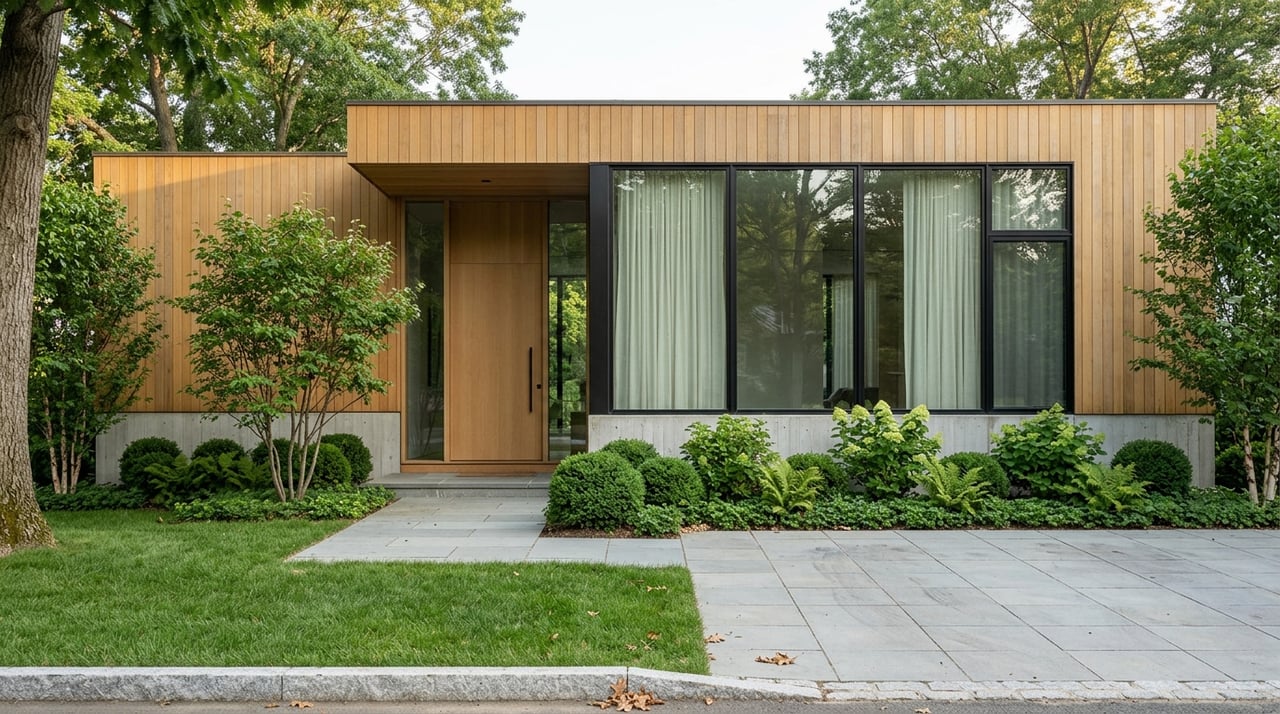
Modern architecture is often associated with clean lines, geometric forms, function-first planning, and innovative materials. In New Canaan, that usually shows up in one-story or low-slung homes, flat roofs, strong horizontal lines, and a close relationship between indoor rooms and outdoor spaces like terraces and courtyards.
That said, modernist homes in town are not all the same. Some lean more toward glass and steel, while others use brick, plywood, or post-and-beam construction. Many feel open and airy, but they may still organize daily living into distinct zones.
Local examples show that range clearly:
- The Hodgson House is one story with a flat roof and brick-and-glass walls.
- The Alice Ball House uses an offset axial plan with terraces.
- The Wiley Speculative House uses post-and-beam construction and an L-shaped plan.
- The Boissonnas House separates bedroom, service, and social areas into distinct pavilions.
Even the Glass House, despite its visual openness, organizes living, dining, sleeping, hearth, and bath areas in a surprisingly traditional way. That is a useful reminder when you tour homes. A house can feel visually open while still supporting day-to-day routines.
Why buyers love the style
For many buyers, the biggest appeal is the relationship between the house and its setting. These homes often bring in exceptional natural light and create a strong sense of flow to the outdoors. If you value views, simplicity, and thoughtful design, modernist homes can feel calm and inspiring in a way that more conventional layouts do not.
There is also lasting appeal in architectural pedigree. In a town like New Canaan, where design history carries real weight, originality and quality can matter as much as square footage. A well-preserved modernist home often offers a different kind of value than a typical luxury property.
What to check before you buy
A modernist home can be a wonderful fit, but it pays to look closely at the practical side. These homes often reward informed buyers who do strong due diligence early.
Start with the building envelope
In many architect-designed homes, the first major issue is not style. It is performance. Flat roofs, expansive glass, and specialized materials can be beautiful, but they also make roof condition, drainage, and water management especially important.
That concern is not theoretical in New Canaan. The 2024 reopening of the Brick House followed restoration after a 15-year closure caused by water infiltration. When you evaluate a modernist home, roof integrity and moisture control should be near the top of your checklist.
Review windows carefully
Original windows are often central to the design. Before assuming they need replacement, it is worth understanding their current condition and what thoughtful repair can achieve. Preservation guidance supports repairing deteriorated historic features when possible, and carefully retrofitted historic windows can offer strong energy and cost performance while preserving character.
For buyers, this matters both aesthetically and financially. Replacing original window systems may affect the look and feel of the home, while repair, weatherstripping, or storm window solutions may better balance comfort and design intent.
Assess mechanical systems
Mechanical, electrical, and plumbing upgrades are common in older modernist houses. Sensitive improvements are often appropriate, especially when they support comfort and efficiency without disrupting important architectural features.
As you review a property, ask about HVAC age, electrical capacity, plumbing updates, insulation strategy, and how prior improvements were installed. Efficient systems with programmable controls can improve livability, but the way they were integrated into the house matters too.
Think about daily livability
Open plans still appeal to many buyers, but they are not automatically perfect for every household. Privacy, noise, storage visibility, and heating or cooling larger open spaces all deserve attention. Smaller enclosed rooms are often easier to condition than one large connected volume.
As you tour, think beyond the wow factor. Ask yourself whether the layout works for your routines, work-from-home needs, guests, and everyday storage. The most successful purchase is not just architecturally interesting. It also fits the way you live.
Preservation and approval questions to ask
Before you plan changes to a modernist property, you need clarity on local rules and restrictions. In Connecticut, no building or structure may be erected or altered in a local historic district until a certificate of appropriateness has been approved.
In New Canaan, the Historic District Commission reviews appearance, materials, components, finishes, measurements, construction methods, scale, and spatial relationships for properties in the district, regardless of age or style. That means a modernist house can be subject to review even if it does not look traditionally historic.
You should also ask whether the property has any separate preservation protection, such as an easement. Some significant New Canaan modern houses do. For example, the Hodgson House is listed on the National Register and protected by preservation easements administered by the National Trust.
Key due diligence questions
Before moving forward, consider asking:
- Is the property in the local historic district?
- Does the home have a preservation easement or other restriction?
- What exterior changes have been made, and were approvals required?
- Would future work on windows, roofing, siding, or additions need review?
- Are there records for major restoration or system upgrades?
These questions can save you time, money, and frustration after closing.
How modernist homes fit the New Canaan market
New Canaan remains a high-priced and relatively active market. In June 2026, Realtor.com reported a median listing price of $2.795 million and 139 active listings, with a median 24 days on market. Redfin reported a trailing three-month median sale price of $1.61 million and about 22 days to sell, while Zillow reported a typical home value of $2.18 million and homes going pending in about 11 days.
These are different measures, but together they point to a market that can move quickly. That is especially important if you are pursuing a distinctive architectural property, where the right home may attract strong interest from buyers who have been waiting for something specific.
Style also matters in pricing. Realtor.com reported that modern homes represented 13.3% of active listings in May 2025 and tended to command higher prices per square foot than English-inspired homes. The same report said modern homes appreciated roughly 43.7% to 44.7% since 2019.
In New Canaan, resale value is likely to depend on more than size alone. Originality, condition, and design quality can play an outsized role. A home that respects its architectural character while addressing practical updates may stand out more strongly over time.
Smart buying strategy for modernist homes
When you buy a modernist home in New Canaan, it helps to stay disciplined. The goal is not just to win the house. It is to understand what ownership will really involve.
Focus on these priorities
Confirm architectural significance
Understand what makes the home notable, distinctive, or well-preserved.Inspect condition closely
Pay special attention to roofing, drainage, windows, and any signs of moisture intrusion.Review past updates
Look at how mechanical and exterior improvements were handled.Check local approvals
Verify whether the property sits in the historic district or has added preservation restrictions.Test the layout for your life
Make sure the home works as well at 7 a.m. on a weekday as it does during a beautiful afternoon showing.
A thoughtful strategy can help you protect both your lifestyle and your investment.
The bottom line
Buying a modernist home in New Canaan is part real estate decision and part stewardship decision. You are choosing a property that may offer beauty, light, and architectural importance, but that may also require more careful planning around maintenance, upgrades, and future changes.
If you approach the search with clear eyes, strong local guidance, and respect for the design, the reward can be extraordinary. The right home can offer not just a place to live, but a deeply considered way of living.
If you are exploring modernist homes in New Canaan or anywhere in Fairfield County, Gina Hackett offers direct, boutique guidance to help you evaluate style, condition, and long-term value with confidence.
FAQs
What makes New Canaan important for modernist homes?
- New Canaan became a major postwar center for residential modernism, with more than thirty modern houses built by the end of 1952 and more than one hundred by the end of the 1970s.
What features are common in New Canaan modernist homes?
- Many have flat roofs, low-slung forms, strong horizontal lines, large areas of glass, and close connections to terraces, courtyards, and the surrounding landscape.
What should buyers inspect first in a New Canaan modern house?
- Buyers should pay close attention to the building envelope, especially roof condition, drainage, water management, and the condition of original windows.
Can you update systems in a historic modernist home?
- Yes, sensitive upgrades to mechanical, electrical, and plumbing systems are generally appropriate when they improve comfort and efficiency while minimizing impact on important historic features.
Do all New Canaan modernist homes have historic restrictions?
- No, but some properties may sit in the local historic district or carry preservation easements, so buyers should verify approval requirements before planning exterior changes.
Are modernist homes a good fit for everyday living in New Canaan?
- They can be, but it depends on the specific layout, privacy needs, storage, and how comfortable you are with open spaces and the upkeep that architect-designed homes may require.