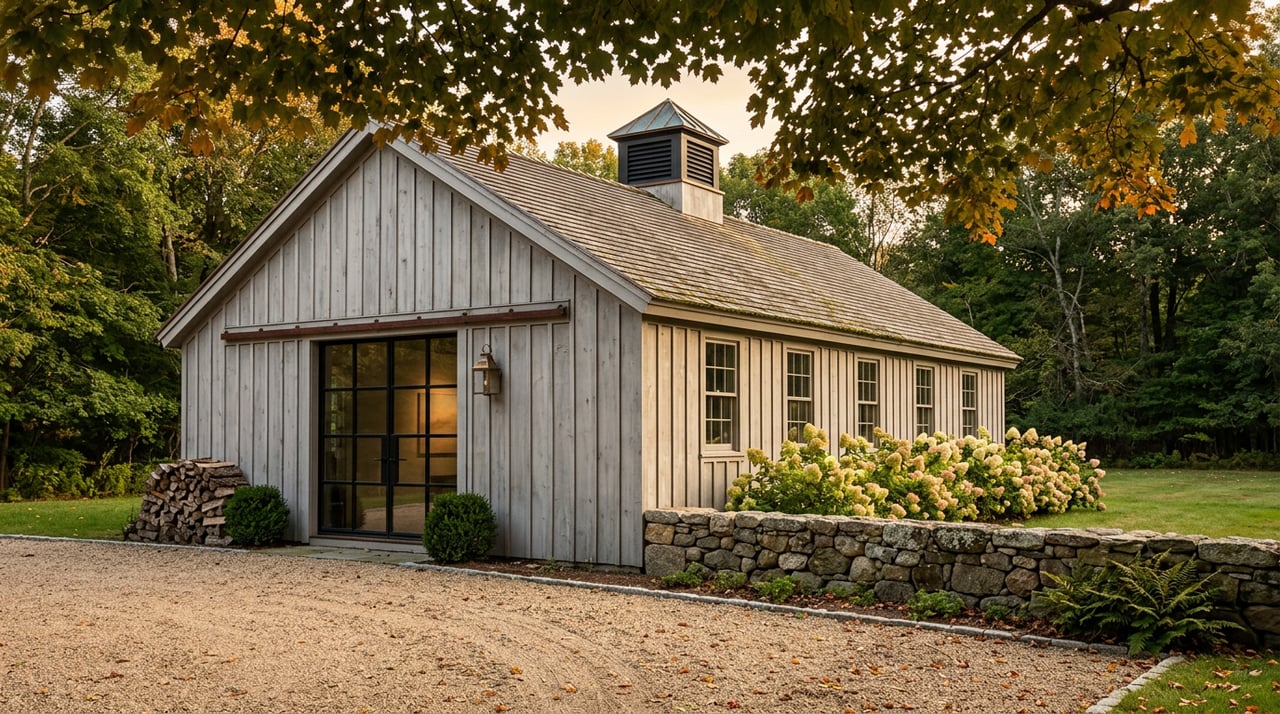
Drive south on Route 7 past the Wilton Center traffic, cross the Norwalk River on a stretch of road narrow enough that two cars still have to negotiate who goes first, and you land in Cannondale before you've had time to notice you left Wilton proper. A white schoolhouse sits at the edge of a train platform. A cluster of barns and outbuildings from the site's 19th-century farm days holds a florist, an antiques dealer, and a shop that has been selling British foods and gifts since 1985. A Metro-North train on the Danbury branch line comes through a handful of times a day and shares its parking lot with dinner reservations.
Most people who live in Wilton know Cannondale as the place with the good restaurant by the tracks. What's easy to miss, even after years of driving through it, is that almost nothing in Cannondale Village has ever done the same job for more than a generation. The schoolhouse has been a school, a café, a grill, a fine-dining restaurant, and now a fine-dining restaurant again under different owners, all inside 150 years. That habit of reuse is not incidental to the village's charm. It is the whole reason the place still exists, and it's about to happen again: the Town of Wilton is currently studying how to protect this same cluster of buildings from a new threat, and the plan for what comes next is being written this year.
A community that ran on itself
The land takes its name from Charles Cannon, who owned much of it in the mid-1800s. After the railroad arrived in 1852, what locals called Cannon's Station grew into a small, self-sufficient settlement: a depot, two general stores, Cannon's own shirt factory, a coal yard, a livery stable, a carriage factory, a blacksmith shop, two rooming houses, and both a town school and two private schools, all within walking distance of each other along the Norwalk River.
That density of unrelated trades packed onto a few acres is part of why Cannondale later qualified for listing as a National Register historic district. The designation covers 58 contributing buildings across roughly 202 acres, stretching along Danbury Road and clustering near the train station, and it recognizes the district specifically because it shows the full range of what a small 19th-century Connecticut community needed to run itself: farming, small manufacturing, transportation, education, and even local government, all in one compact footprint.
The building that keeps changing jobs
No structure in the village illustrates the pattern better than the schoolhouse itself.
| Era | The Schoolhouse's Job |
|---|---|
| 1872 | Built as Cannondale's schoolhouse |
| December 1979 | Moved a quarter mile to its current site on the Norwalk River, reopening as the Old Schoolhouse Café and Riverside Gardens |
| 1991–2005 | Became the Olde Schoolhouse Grill, whose regulars reportedly included Paul Newman, Eileen Heckart, and Keith Richards |
| After 2005–2021 | Reopened as the Schoolhouse at Cannondale under chef Tim LaBant |
| 2021–today | Became Baldanza at the Schoolhouse under Angela and Sandy Baldanza, who mark five years in the building this August |
The move in 1979 was not a quiet one. When actress June Havoc, who had bought the surrounding property in 1978, decided to relocate the schoolhouse to its current riverside spot, the town turned it into an event: an ice cream social and a parade led by the Wilton High School marching band, with more than 100 people, including former Cannondale School students, watching the building inch its way toward the Norwalk River behind a Norwalk moving company's equipment.
Havoc was the village's most consequential owner. She restored its pre-Civil War barns and outbuildings, and according to a 1980 wire story she described the property as
"the end of the rainbow."
She sold it in 1989, and it has changed hands more than once since, but the pattern she set, buy the shell, keep the use flexible, held.
What's still doing business there now
A handful of the current tenants have been in Cannondale long enough to count as fixtures in their own right:
- Penny Ha' Penny, a British food and gifts shop that has operated out of the village since 1985
- Annabel Green, a florist and boutique carrying flowers and home accents inside one of the restored outbuildings
- An antiques dealer specializing in porcelain and art ceramics, with a storefront on Cannon Road
- Baldanza at the Schoolhouse, marking its fifth year in the building this month
None of these businesses occupy a building built for their trade. Annabel Green works out of what was once a farm structure. The antiques shop sits inside a village built for shirt-making and dry goods. That mismatch between original purpose and current use is not a workaround. It is, at this point, the district's defining trait, and it's also why Cannondale carries a protective zoning designation few residents think about day to day: it's one of only two Village Districts in Wilton, alongside Wilton Center, meaning any new construction or major renovation there has to go through the town's Village District Design Advisory Committee before it can move forward.
The next rebuild is already on the calendar
Here is what most people driving through Cannondale this year don't know: the town commissioned a formal study of the district's flood risk, dated January 13, 2026, and prepared by Building Conservation Associates, a New York preservation architecture firm, alongside RACE Coastal Engineering out of Stratford. The report, titled Historic Cannondale Village Flood Risk and Mitigation, sits inside a broader Cannondale Area Pre-Master Planning Study, and it led directly into a March 10, 2026 public meeting billed around a "Revitalization Roadmap" for the district.
The study's own agenda spells out exactly what's on the table: environmental risk and mitigation options, the economic impact of historic preservation choices, adaptive reuse strategies, and site accessibility. In plain terms, the town is asking the same question Havoc effectively answered by hand in 1978 and 1979, and that Tom King, Tim LaBant, and the Baldanzas each answered again every time they took over the schoolhouse: how do you keep using a cluster of 19th-century buildings sitting a few feet from a river without losing what makes them worth using in the first place. This time the pressure is water, not vacancy, but the underlying decision is the same one the village has made every generation since Charles Cannon's mill economy gave way to Havoc's restoration.
Why this is worth watching if you're already here
If you live in or near Wilton, the practical upshot is this: whatever comes out of the town's planning process this year will shape whether Cannondale keeps its current mix of businesses, adds flood mitigation infrastructure that changes how the buildings sit relative to the river, or opens the door to the kind of adaptive reuse the National Register designation was written to accommodate in the first place. None of that happens quickly, and nothing in the study suggests the district is at risk of losing its character. But a plan written in 2026 is the kind of thing that quietly determines what your kids' kids drive past on Cannon Road in thirty years, the same way a plan written sometime around 1978 determined what you drive past today.
I've walked Cannondale more times than I can count, usually on the way to a listing nearby or a dinner at Baldanza with clients who end up asking the same question every time: what is this place, exactly. Now you have the fuller answer. It's a village that has never once tried to freeze itself in time, and that's precisely why it's still standing.
If you're weighing a move within Wilton, or you're simply curious what a piece of property near a village like this is worth in today's market, I'm always glad to talk it through. Request Your Home Valuation anytime, or reach out directly through Gina Hackett.